Negative‑Resistance Behavior of the Diode Plug

  • 298 Views
  • Last Post 3 weeks ago
baerndorfer posted this 4 weeks ago

What "negative resistance" means  
In linear circuits, resistance always absorbs real power.  
But the diode plug is nonlinear and time‑variant, so there are intervals where it returns energy to the AC source.  
When analyzing only the fundamental AC component, this can appear as:

\(
G = \frac{P_1}{|V_1|^2} < 0
\)

A negative conductance \(G\) corresponds to an apparent negative resistance.  
This does not violate energy conservation — it is a measurement artifact of nonlinear energy flow.
Why the diode plug behaves this way  
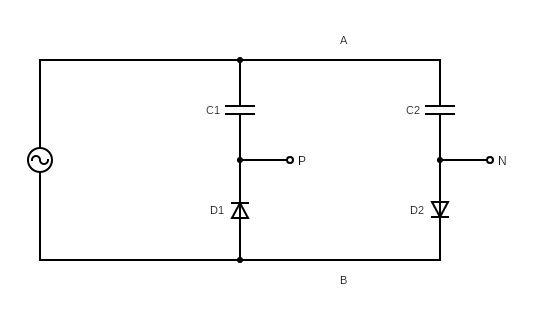
The diode plug uses two rectifying branches feeding two capacitors.  
Because the diodes conduct only during specific parts of the AC cycle:

- Charging intervals: energy flows from the AC node into the capacitors → positive instantaneous power  
- Discharging intervals: energy flows from the capacitors back into the AC node → negative instantaneous power  

When averaged and reduced to the fundamental, the returned energy can exceed the absorbed energy at that frequency, producing an effective negative real power.

The diode plug strongly distorts the AC waveform:

- clips parts of the cycle  
- injects harmonics  
- shifts current relative to voltage  

Because the fundamental component is only a slice of the total waveform, it can show a net negative real power, even though the total instantaneous power is always non‑negative.

Thus the device can appear to behave like a source at the fundamental frequency.

The capacitors charge in short pulses rather than smoothly. This pulsed charging makes the device appear more capacitive than a simple capacitor.

The imaginary part of the admittance:

\(
B = \frac{Q_1}{|V_1|^2}
\)

often becomes negative, indicating capacitive behavior.  
Increasing capacitance increases:

- waveform distortion  
- reactive power  
- the magnitude of the apparent negative resistance  

---

How the negative resistance is measured:
Voltage and current at the AC node are sampled and transformed via FFT.  
The fundamental components give:

\(
Y_{eq} = \frac{I_1}{V_1} = G + jB
\)

Where:

- \(G < 0\) → apparent negative resistance  
- \(B < 0\) → capacitive behavior  

This linearized model describes how the diode plug interacts with a resonant tank or AC source at the fundamental frequency.

---

The diode plug does not generate energy.  
It redistributes energy between harmonics and between the AC node and its capacitors.

When viewed only at the fundamental frequency, this redistribution can look like:

- negative resistance (returning real power)  
- negative susceptance (strong capacitive effect)  

But the total energy always obeys conservation laws!

Diode-Plug in general

Order By: Standard | Newest | Votes
baerndorfer posted this 4 weeks ago

What "negative resistance" means  
In linear circuits, resistance always absorbs real power.  
But the diode plug is nonlinear and time‑variant, so there are intervals where it returns energy to the AC source.  
When analyzing only the fundamental AC component, this can appear as:

\(
G = \frac{P_1}{|V_1|^2} < 0
\)

A negative conductance \(G\) corresponds to an apparent negative resistance.  
This does not violate energy conservation — it is a measurement artifact of nonlinear energy flow.

Why the diode plug behaves this way  
The diode plug uses two rectifying branches feeding two capacitors.  
Because the diodes conduct only during specific parts of the AC cycle:

- Charging intervals: energy flows from the AC node into the capacitors → positive instantaneous power  
- Discharging intervals: energy flows from the capacitors back into the AC node → negative instantaneous power  

When averaged and reduced to the fundamental, the returned energy can exceed the absorbed energy at that frequency, producing an effective negative real power.

The diode plug strongly distorts the AC waveform:

- clips parts of the cycle  
- injects harmonics  
- shifts current relative to voltage  

Because the fundamental component is only a slice of the total waveform, it can show a net negative real power, even though the total instantaneous power is always non‑negative.

Thus the device can appear to behave like a source at the fundamental frequency.

The capacitors charge in short pulses rather than smoothly. This pulsed charging makes the device appear more capacitive than a simple capacitor.

The imaginary part of the admittance:

\(
B = \frac{Q_1}{|V_1|^2}
\)

often becomes negative, indicating capacitive behavior.  
Increasing capacitance increases:

- waveform distortion  
- reactive power  
- the magnitude of the apparent negative resistance  

---

How the negative resistance is measured:
Voltage and current at the AC node are sampled and transformed via FFT.  
The fundamental components give:

\(
Y_{eq} = \frac{I_1}{V_1} = G + jB
\)

Where:

- \(G < 0\) → apparent negative resistance  
- \(B < 0\) → capacitive behavior  

This linearized model describes how the diode plug interacts with a resonant tank or AC source at the fundamental frequency.

---

The diode plug does not generate energy.  
It redistributes energy between harmonics and between the AC node and its capacitors.

When viewed only at the fundamental frequency, this redistribution can look like:

- negative resistance (returning real power)  
- negative susceptance (strong capacitive effect)  

But the total energy always obeys conservation laws!

Diode-Plug in general

Jagau posted this 3 weeks ago

Hi Bearndorfer

That's a great analysis you've done here, And you are 100% correct in the statement of the closed system presented.

In the statement:

But the total energy always obeys conservation laws!

Luckily, this law doesn't apply to open systems because I would have given up a long time ago.

To complement your study, it would be interesting to see this analysis applied to an open system. One example is Avramenko's AV plug, Zaev N. E. Avramenko S. V., Lisin V. N. have done a detailed study of it which I've attached as a PDF.

What they found is very interesting.

Jagau

What we consider to be empty space is merely a manifestation of unawakened matter. N.T.

Attached Files

baerndorfer posted this 3 weeks ago

yes only for closed systems man 😎

thx for the paper! i will study and continue my journey.

regards

B

Jagau posted this 3 weeks ago

Yes, very well my friend, we understand each other perfectly.

I think you'll like the conclusions of the paper.

I'm still studying the one on your website that you linked to.

Diode-Plug in general

very, very interesting.

Jagau

What we consider to be empty space is merely a manifestation of unawakened matter. N.T.

baerndorfer posted this 3 weeks ago

the thing is, that one have to decide in which framework he likes to think. because of my background i have to go with 'classical electromagnetics'. Avramenko and others describe the phenomena from a different perspective like kind of field-oriented view. depending on 'standpoint' the diode-plug can be OU or not 😎

when we reach the goal then there is no paperwork needed because it will be obvious.

regards

B

Inception posted this 3 weeks ago

Jagau,

The article is very interesting. To cut to the chase, I focused on the Measurement section.

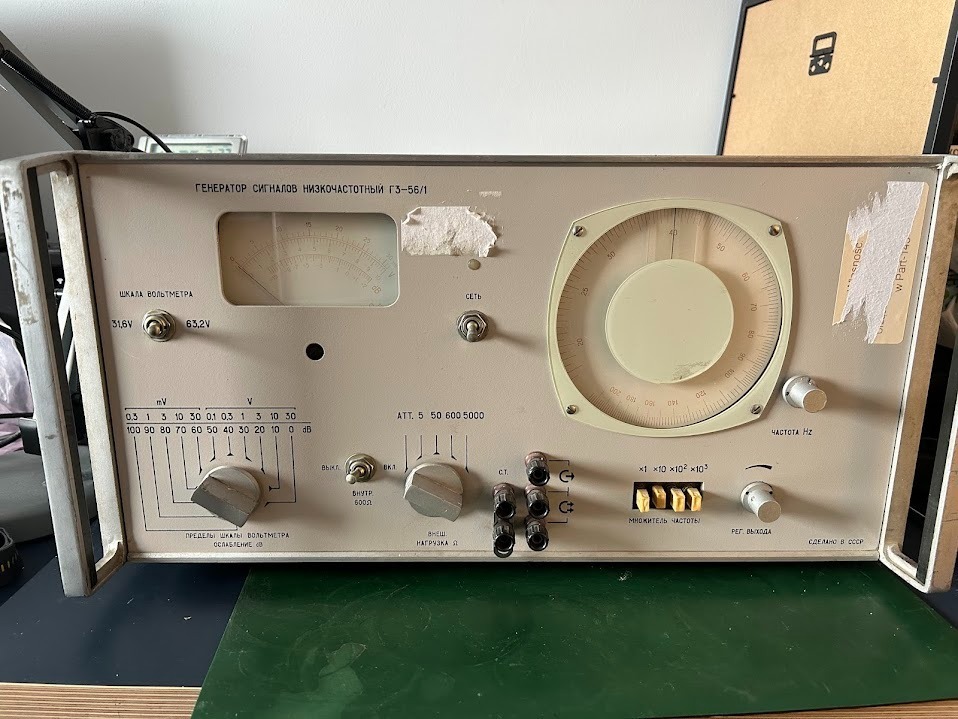
Avramenko's "AC voltage source is a sound generator G3-56/1". The total frequency range is 20 Hz to 200 kHz.

The D208 refers to a Soviet-era general-purpose silicon alloy diode: Д208

Peak Reverse Voltage: 300 V.
Average Forward Current: 100 mA.
Operating Frequency: Up to 1 kHz for standard operation, though it can operate at higher frequencies with increased reverse current (up to 500 µA).

Avramenko’s forks often operate at high frequencies (kilohertz to megahertz range) to capture displacement currents. Modern equivalents should prioritize higher speed (fast recovery) and appropriate voltage ratings: 

Standard Rectifiers (General Use):

1N4004: Rated for 400V / 1A.  Slow recovery times, limiting performance in high-frequency setups.

UF4004: An "Ultra Fast" version of the 1N4004, better suited for the high-frequency pulses often found in Avramenko's experiments.

High-Speed/High-Frequency Equivalents:

HER104 or HER208: The HER208 specifically handles up to 1000V / 2A with a very fast recovery time of 75ns.

1N4937: Fast recovery rectifier rated for 600V / 1A.

BAV21: A high-speed switching diode (250V / 200mA) suitable if the current requirements are low but frequency is high.

Russian Alternatives:

KD208A (КД208А): A later Soviet/Russian equivalent rated for 150V / 0.5A.

D209, D210, D211: Direct members of the same family as the D208 but with higher voltage ratings (400V, 500V, and 600V respectively). 

Avramenko's measurements were done at low frequencies, using electronics available in the 80's.

This highlights two points:

1) Tests can be done by any experimenter, with basic audio equipment and inefficient components, to demonstrate the principle of single-wire power transmission.

2) Using high-speed/high-frequency components, with modern signal and measurement equipment, the results should reveal greater efficiency.

Inception

Close