The different ways to charge a battery

  • 428 Views
  • Last Post 5 hours ago
Inception posted this 4 weeks ago

I also have purchased the smaller Universal Charger, which refurbishes all types of batteries. I started the large battery project with it, but because it was intended for smaller batteries I thought I should use the industrial types to speed up the process. 
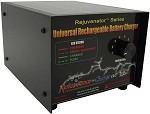
The Universal charger has given new life to my collection of automotive batteries, as long as the cells have not swelled too much from winter freezing. I have dozens of 10+ year old refurbished batteries: 26 were 7V Prius "BAD" NiMH modules that I got online, which are ~20 years old.

I accidently revived a Lithium razor battery thinking it was NiMH, which is not recommended, however, the charger was very effective nonetheless.

Every experimenter should have something like this, to keep ALS batteries desulfated and NiMH at full capacity. If you have not made your own radiant energy battery charger, consider getting something like the RC-1AU Universal Battery Charger.

Inception

  • Liked by
  • Jagau
  • Fighter
Inception posted this 6 hours ago

Latest development for charging the industrial batteries in my previous post:

I was able to bring back one battery, so it can be charged by the Trace Inverter/Charger.

However, the other battery had more frost-heave damage, and has gone through several refurbish recycles, losing voltage, instead of gaining voltage.

Note: The industrial 2V rejuvenator has been used on several of the cells, but the over-all voltage would not come up. 

One half of the 24V battery started at 8V+ and, after cycling, reduced to 4V. I checked each cell and most were around 1.9V to 2V. One cell was MINUS 4 Volts!

This is the first time I have experienced a negative voltage cell, which a battery scientist insists cannot be reversed:

Most likely someone has charged the battery mistakenly in reverse. A lead acid battery has lead materials in both electrodes that can polarize in the opposite direction when charged in reverse. Attempts to correct the situation by charging in the correct direction are fruitless because a key organic ingredient in the normal negative electrode will have been oxidized during the reversal. Furthermore, the chances of a short developing during a reversal is high. The battery cannot be recovered to a well functioning state.

I am determined to test this statement by discharging the cell and applying a positive pulsed charge using my Universal Charger, which is much weaker than the industrial 2V rejuvenator, and intended for smaller batteries. If it can push any current through the cell, it will continue to charge it, otherwise it thinks the cables are either disconnected, or the cell is shorted.

Since I am away from that site for the holidays, to facilitate repairs at home, I will have to wait to try this until next year.

Any suggestions are welcome in the interim.


Inception

Inception posted this 5 hours ago

Quoting:baerndorfer

this is my circuit if someone like to replicate. 
regards

B

What is the difference between the E80/38/20-3C95 and the E80/38/20-N95 cores?

E80/38/20 N95

E80/38/20 data book

Inception

Close